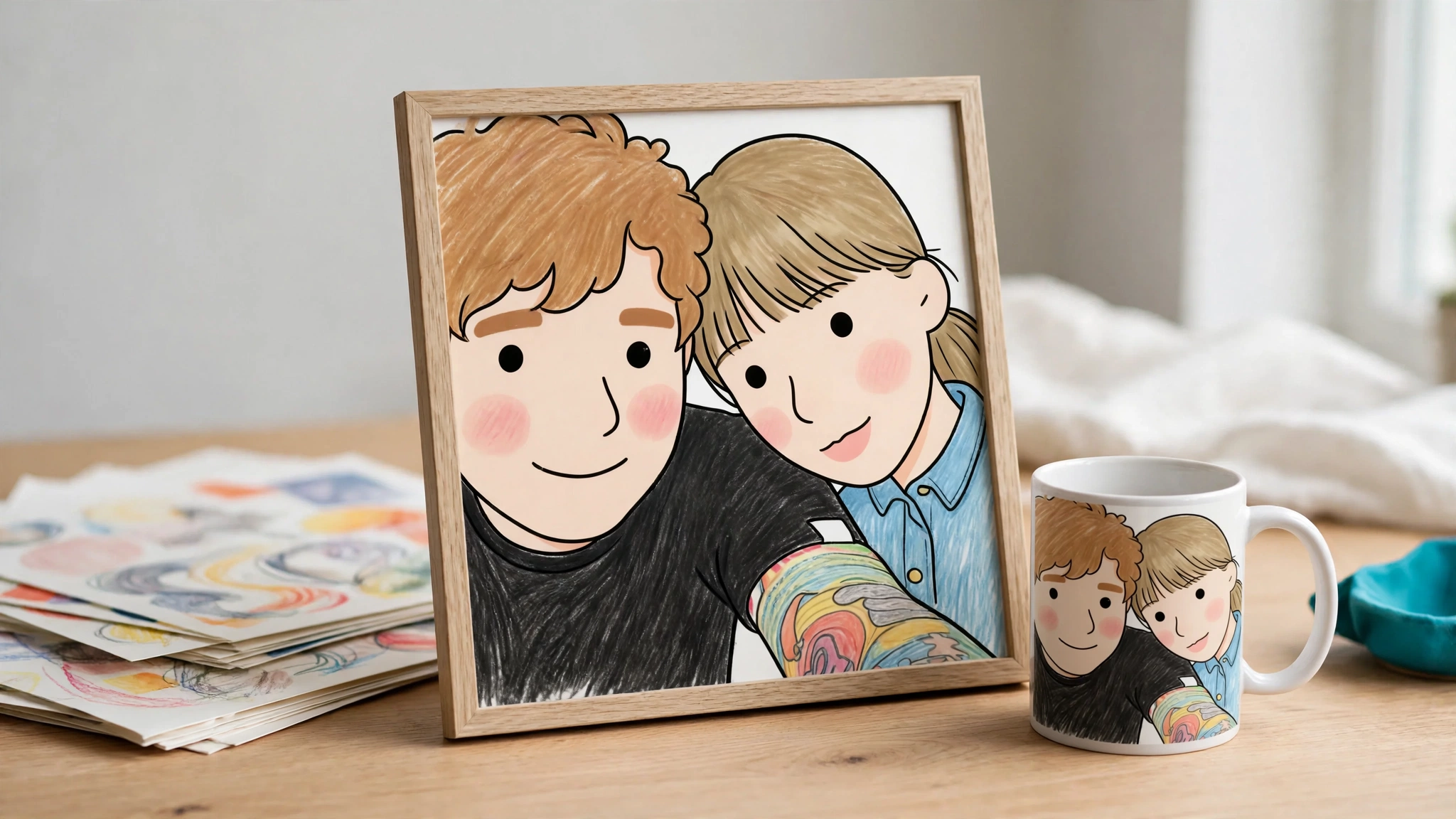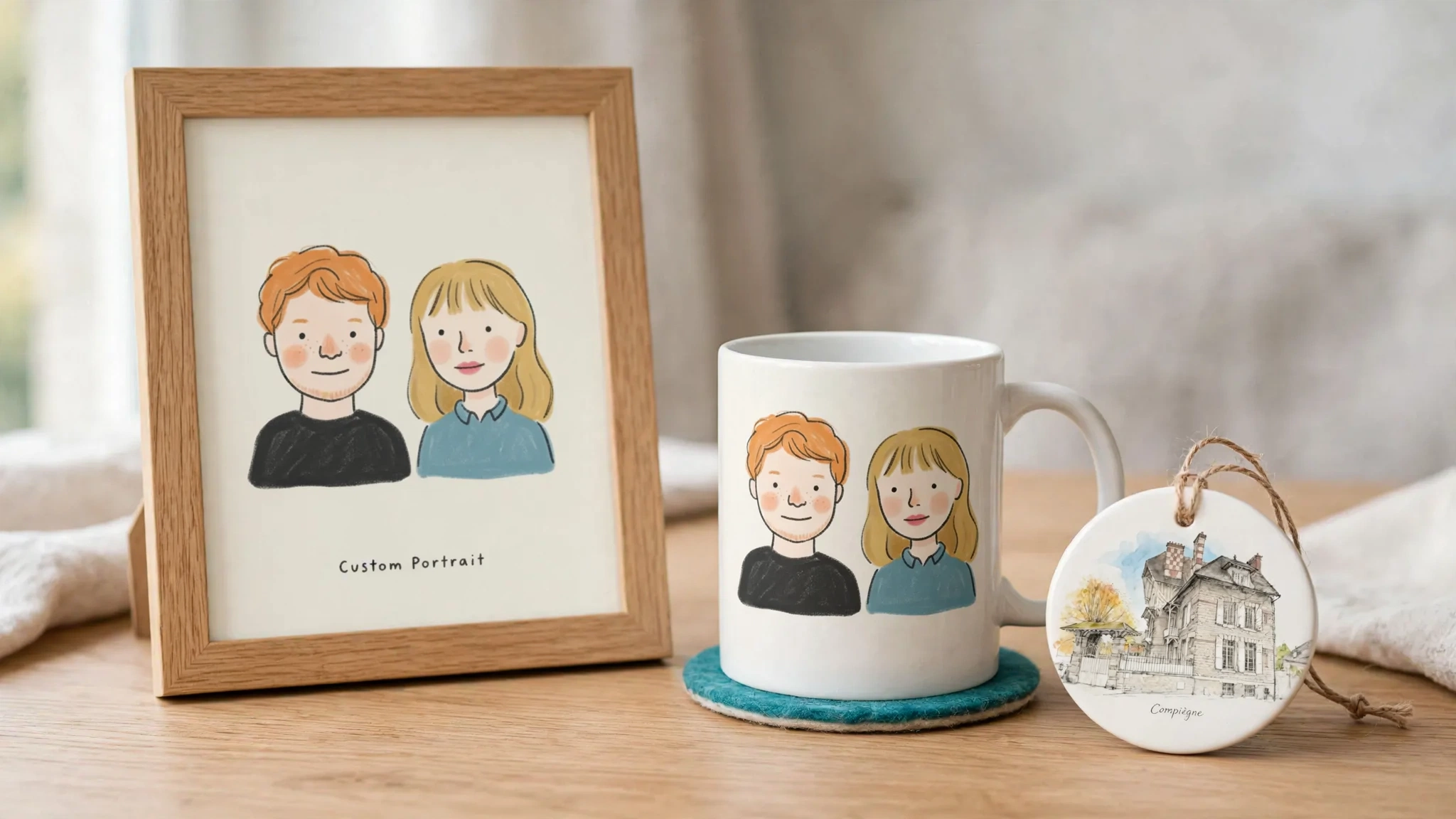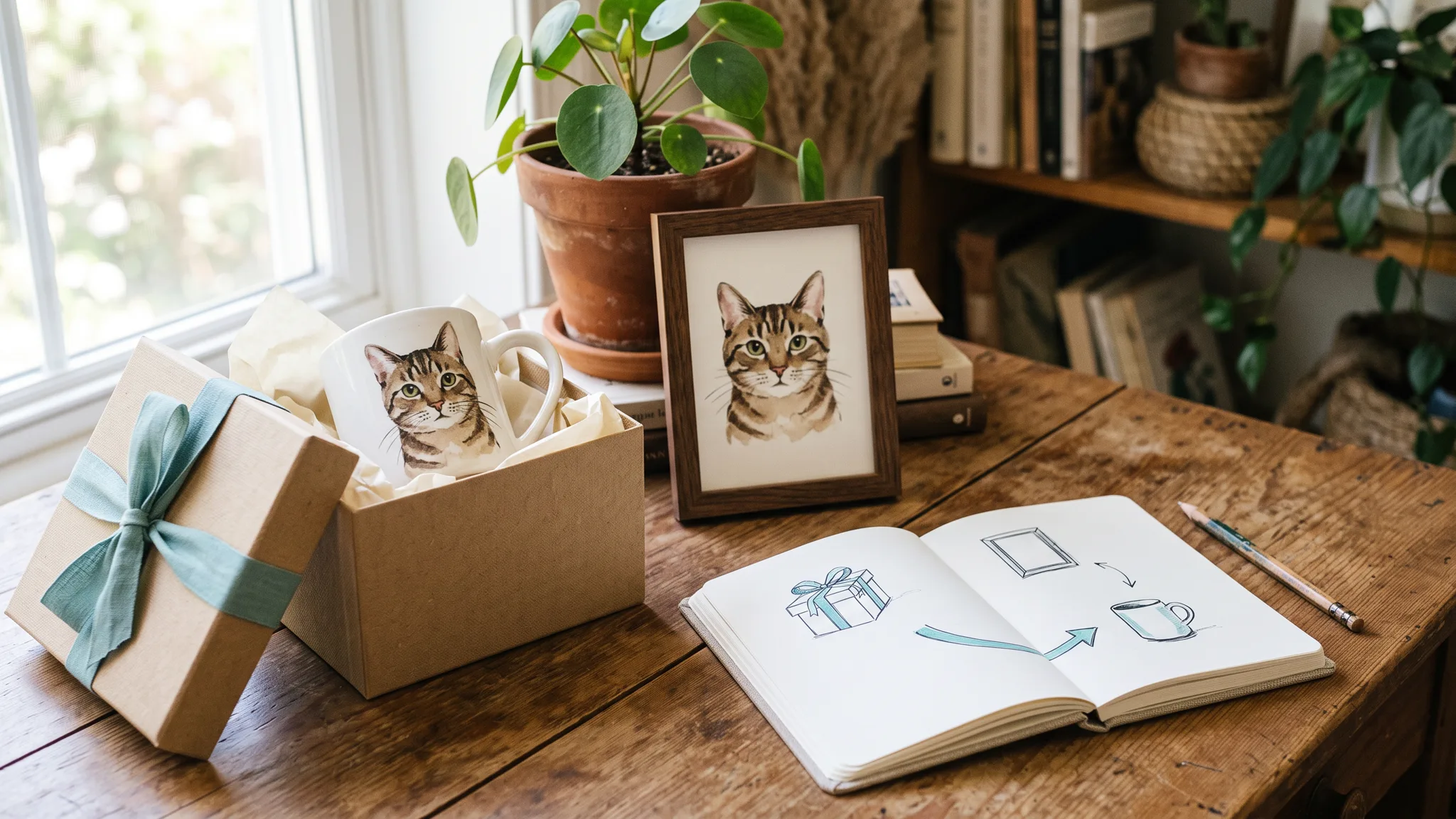
To start a personalized gift business, pick one gift for one buyer and one occasion, let a print-on-demand supplier make and ship it, and decide how the shopper will personalize it before you choose any other tool. That last decision sets your costs and your workload. A name on a mug needs a text field. A pet photo that becomes a painted portrait needs an app such as Personalize.design, which shows the shopper the result before checkout and attaches a print-ready file to the order. This guide gives the startup costs, the four ways to personalize, the margin on a $39 gift, and a launch checklist.
Prices and fees below were read on each company’s own page on 10 November 2026. They change, so check the page before you commit.
The short version
- You can open a store for $39 a month on Shopify, or $1 a month for the first three months on its current offer. Printful and Printify both have a $0 plan.
- Pick the gift by what the shopper gives you: a name, a photo used as it is, or a photo that becomes new artwork.
- In our example, a $39 photo-to-art poster leaves $23.12 per order before AI generation and ads. Three orders a month cover $68 of fixed fees.
- Interest peaks late. US searches for “personalized gift business” reached 880 a month in November and December 2025, against 260 in September 2026.
- If your gifts only need a name or a date, you don’t need Personalize.design. A product options app is cheaper.
What is a personalized gift business?
A personalized gift business sells products that are changed for one recipient: a name, a date, a photo, a drawing of their dog. The buyer is rarely the person who keeps the product. They’re shopping for a birthday, a wedding, a new baby, a lost pet or the holidays, and they usually have a date in mind.
There are two ways to run one, and some sellers mix them.
| Model | You need | You handle | Fits |
|---|---|---|---|
| Make it yourself | An engraver, an embroidery machine or a heat press, plus stock | Production, packing, shipping | Wood, leather, jewelry, embroidered goods |
| Print on demand | A store and a supplier account | The product page, the artwork, customer service | Mugs, posters, canvas, blankets, apparel |
This guide follows the print-on-demand route, because it has no stock and no equipment to buy. Printful says it plainly on its pricing page: “there are no monthly fees to create products or connect your store.” The supplier prints one item when one order arrives and ships it to the recipient.
The trade-off is that every seller can offer the same blank mug. What sets you apart is the personalization and the artwork, which is why the next decisions matter more than the supplier.
When should you start?
Earlier than most people do. Google’s keyword data puts US searches for “personalized gift business” at 880 a month in November and December 2025. From January to September 2026 the figure sat between 260 and 480, with 260 in September.
The idea is most popular in the weeks when it’s hardest to act on. A new store has no reviews and no tested product, and a late parcel in December means a refund. If you’re reading this in November, launch one gift, sell it to people who already know you, and use the season to learn what breaks. Build the catalog in January, when a mistake costs less.
Two dates matter more than your launch date: the last day your supplier will accept an order for delivery before the holiday, and the day you stop promising delivery on your product page. Ask your supplier for the first and print the second on the page.
What does it cost to start a personalized gift business?
You pay for a store, sometimes an app, and a sample. These are the fixed fees for the tools most new sellers use.
| Tool | Plan | Price | What else you pay |
|---|---|---|---|
| Shopify | Basic | $39 a month, or $29 a month billed yearly | Card fee of 2.9% + 30¢ per online order |
| Etsy | No monthly plan needed | $0.20 per listing | 6.5% of the order total, plus payment processing |
| Printful | Free | $0 a month | The product and shipping, per order |
| Printify | Free | $0 a month | The product and shipping, per order |
| Personalize.design | Build | $0 a month | AI generation at cost while you test |
| Personalize.design | Launch | $29 a month, or $290 a year | $0.45 per personalized item sold, plus AI generation at cost |
Shopify’s current offer is three days free, then $1 a month for the first three months. Launch has a 14-day trial that waives the subscription and the item fee. AI generation is billed at cost from the first use, including during the trial.
Both suppliers sell a paid plan you can ignore at first. Printful Growth is $24.99 a month and lists up to 33% off product prices; it becomes free once you reach $12,000 a year in sales. Printify Premium starts at $39 a month, or $24.99 a month billed yearly, and lists up to 20% off all products.
That gives two realistic starting budgets on Shopify:
- Text gifts with a product options app: $39 a month. Some options apps have a free plan, and our customizer guide below lists one.
- Photo-to-art gifts with Personalize.design: $68 a month once you publish, plus $0.45 per item and AI generation.
Add a sample order of each product you plan to sell. Don’t skip it. The sample is the only way to know what the recipient will unwrap.
Which personalized gift should you sell first?
One gift, for one buyer, for one occasion. “A watercolor portrait poster for people who just lost a dog” tells you what to build, what to charge and where to find buyers. “Custom gifts for everyone” puts you up against Etsy’s personalized gifts page, which ranked first for this search when we checked.
No public dataset tells you which gift will sell in your store, and the guides that rank for this topic list the same ideas: mugs, photo books, wall art, blankets, calendars. A better filter is what the shopper has to give you, because that decides how much work each order creates.
| The shopper gives you | Typical gifts | Work per order |
|---|---|---|
| A name, a date, a short message | Mugs, ornaments, tote bags, engraved boards | Low: the text goes into a fixed design |
| A photo, used as it is | Photo mugs, blankets, phone cases, calendars | Low to medium: cropping and photo quality |
| A photo that becomes artwork | Pet portraits, family posters, house portraits | High by hand, low with an AI personalizer |
| A description | Custom illustrations, story books | High: someone has to draw or write it |
Text gifts are the easiest to launch and the easiest to copy. Photo-to-art gifts can carry a higher price, since the shopper is buying a picture of their own dog, child or house. They used to need an illustrator for each order. An AI personalizer now generates that artwork from the shopper’s photo.
If you want a worked product to copy, we wrote one for pet portraits, one for family posters and one for house portraits.
How will shoppers personalize the gift?
This is the decision most guides skip. They list a store builder, a supplier and a design tool, then stop before the product page. On a personalized gift, the product page carries the sale. The shopper has to give you something, and they want to see what they’ll get before they pay.
There are four kinds of tool, and we compare them app by app in our Shopify product customizer guide.
| Tool | The shopper does | You receive | Fits |
|---|---|---|---|
| Product options app | Types a name, picks from a list | Text saved on the order | Name and date gifts |
| Layered template editor | Fills fixed slots with text, clipart or a photo | A print file built from your template | Fixed layouts with many variations |
| Configurator | Picks parts, colors, sizes | A configured product | Products built from components |
| AI personalizer | Uploads a photo, answers a few questions | New artwork and a print-ready file | Photo-to-art gifts |
Your supplier may cover the first row on its own. Printful, for example, describes a personalization tool that lets customers add their own touches to an order.
With Personalize.design, you write the recipe once as an AI Blueprint: the style, what the shopper must provide, and the output rules. The shopper uploads a photo on the product page and sees the generated preview before checkout. When they pay, the print-ready artwork is attached to the order. You can read the full workflow in how to sell personalized products on Shopify with AI.
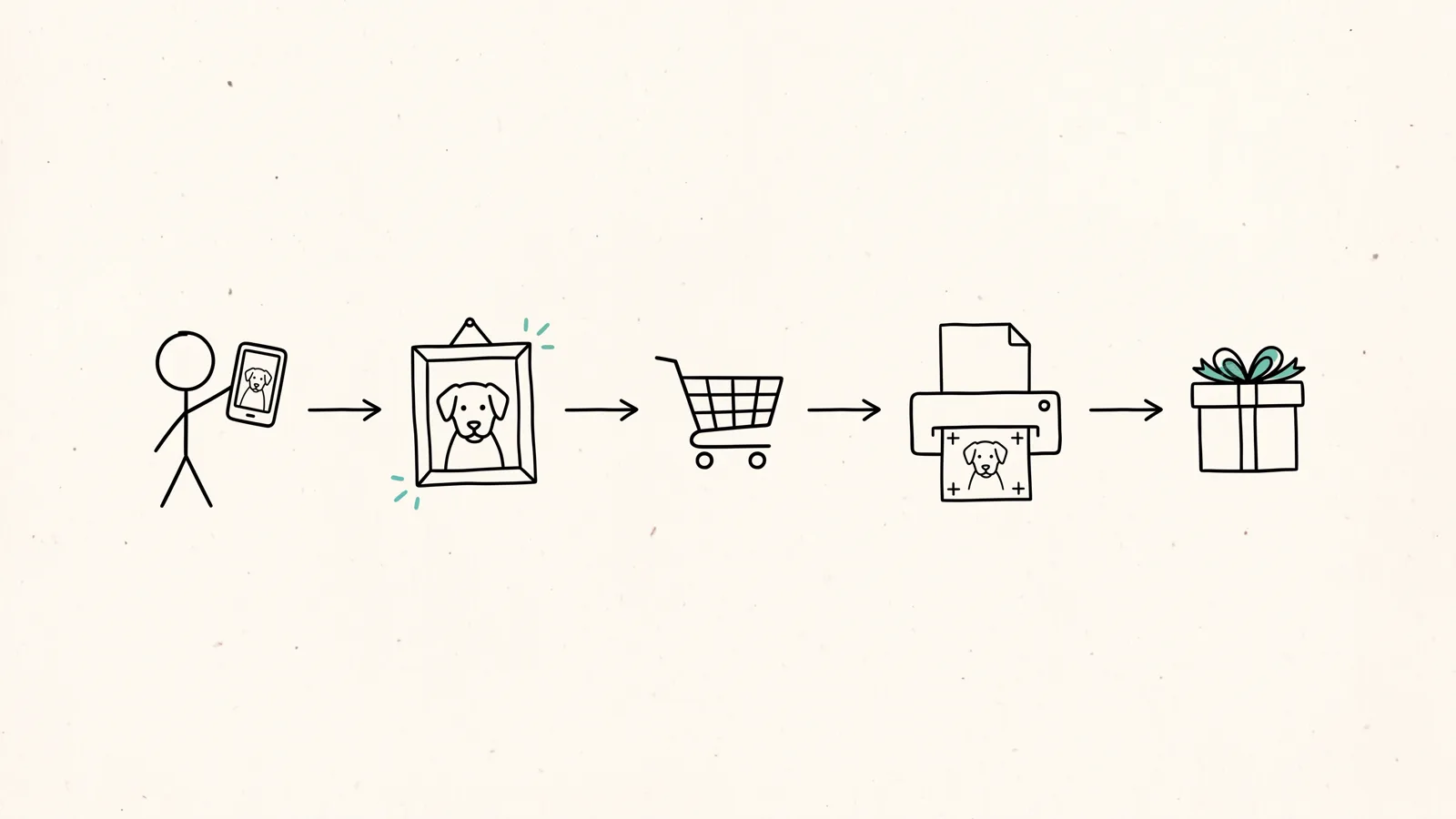
Whichever tool you pick, test the same three things before you pay for it. Do the whole flow on a phone. Place a test order and open the file your supplier would print. Upload a bad photo, dark or blurry, and see what the shopper is told. The difference between a preview that is drawn live and one that is generated is covered in live preview vs AI-generated preview.
How much can you make per gift?
Here is one order, worked through. The fees are real. The selling price and the supplier cost are example inputs, so replace them with the numbers from your own supplier’s catalog.
| Line | Amount |
|---|---|
| The shopper pays, shipping included | $39.00 |
| Supplier: print and shipping (example input) | −$14.00 |
| Shopify card fee, 2.9% + 30¢ | −$1.43 |
| Personalize.design item fee | −$0.45 |
| Left per gift, before AI generation and ads | $23.12 |
Fixed fees in this setup are $68 a month: $39 for Shopify Basic and $29 for Launch. Three gifts a month cover them. At 30 gifts a month, $625.60 is left after those fixed fees, before AI generation and ads.
Two costs are missing from the table on purpose, because they depend on you.
AI generation is billed at cost and happens at preview time. A shopper who generates a portrait and leaves has still cost you a generation. The app lets you set a spending limit, and you should set one before you send traffic to the page.
Ads are the larger unknown. If you plan to buy traffic, your margin per gift has to pay for the clicks that don’t convert. Start with people who already know you, a pet group, a local club, your own customers, and buy ads once you know your conversion rate.
On Etsy, the same $39 order costs $2.54 in transaction fee and $0.20 for the listing, plus a payment processing fee that varies by country. There’s no monthly fee, which makes Etsy a fair place to test demand for a text gift before you open a store.
One way to raise the number without raising the price is to sell the same artwork twice: the poster, plus a mug or an ornament with the same portrait. We cover that in how to increase AOV with product personalization.
Do you need a license or permission?
Probably some registration, and it depends on where you live. The US Small Business Administration says most small businesses need a combination of licenses and permits from federal and state agencies, and that local governments set their own registration and permit rules. Check your city and state before your first sale, and ask about sales tax while you’re there.
Permission is the part specific to gifts. The US Copyright Office says that if you use a copyrighted work without authorization, the owner may be entitled to bring an infringement action against you. In practice:
- Don’t print cartoon characters, sports logos, song lyrics or celebrity faces unless you hold a license.
- Ask shoppers to upload only photos they took or have the right to use, and say so next to the upload button.
- Tell shoppers what happens to their photo after the order.
This is general information, not legal advice.
A launch checklist for your first gift
- Write the sentence: this gift, for this buyer, for this occasion.
- Choose the product and order a blank sample from your supplier.
- Choose the personalization tool by what the shopper gives you.
- Build the product and personalize it yourself with five real photos or names, including a bad one.
- Place a test order. Open the print file at full size.
- Order a personalized sample and photograph it for the product page.
- Write the page: what the shopper provides, what they’ll see, when it ships, and what you do if the print is wrong.
- Set a refund rule for personalized items and put it on the page.
- Sell to ten people you can ask for feedback. Fix what confused them.
- Only then add a second gift.
For the Shopify steps in detail, follow how to sell AI-personalized products on Shopify.
When is Personalize.design the wrong tool?
It’s the wrong tool in five cases.
- Your gifts need a name, a date or a monogram. Use a product options app. Shopify product options vs AI personalization shows where the line is.
- You sell fixed layouts where the shopper picks clipart and fills slots, like a family of cartoon figures with names. A template editor such as Customily or Teeinblue is built for that. See how Customily compares.
- You make the gift by hand. You need an order form and a good camera more than you need a print file.
- You don’t sell on Shopify. Personalize.design is a Shopify app.
- You want proof from other merchants first. The app’s Shopify listing had no reviews on 10 November 2026.
It fits when the gift is a picture made from the shopper’s photo, you want the shopper to see it before paying, and you don’t want to draw each order.
Frequently asked questions
How do I start a personalized gift business from home?
Use print on demand so you hold no stock. Open a store, connect a supplier such as Printful or Printify, add one product, and choose how the shopper personalizes it. Order a sample before you sell. You can run the whole thing from a laptop.
How much does it cost to start a personalized gift business?
On Shopify with a free supplier plan, $39 a month, or $1 a month for the first three months on the current offer. Adding Personalize.design for photo-to-art gifts brings fixed fees to $68 a month once you publish. On Etsy there is no monthly fee: you pay $0.20 per listing and 6.5% of each order.
What personalized items sell well?
There’s no public sales data for small stores, so be wary of lists that claim to know. The gifts that appear in most guides are mugs, wall art, blankets, photo books and calendars. Choose by occasion and by what the shopper has to give you, then test one product.
Is a personalized gift business profitable?
It depends on the gap between your price and your supplier cost, and on what you pay for traffic. In the example above, a $39 poster leaves $23.12 before AI generation and ads. A lower-priced text gift leaves less per order, so it needs more orders or a second item in the cart.
Do I need a business license to sell personalized gifts?
Rules vary by country, state and city. In the US, the Small Business Administration says most small businesses need a combination of federal and state licenses and permits. Check your local government’s site before you sell.
Can I start on Etsy instead of Shopify?
Yes, and for a text gift it’s a cheap test. Etsy charges $0.20 per listing and 6.5% of the order total, with no monthly fee. You get Etsy’s shoppers, and you share the page with every similar gift.
Sources
Facts about each company come from the pages below, read on 10 November 2026.
- Shopify pricing (US prices)
- Etsy Help: fees for selling on Etsy
- Printful pricing
- Printify pricing
- Personalize.design on the Shopify App Store
- Printful: top tools to start a personalized gift store
- Printbox: how to start a personalized gift business
- US Small Business Administration: apply for licenses and permits
- US Copyright Office: fair use FAQ
- Search volumes and the search ranking: Google data for the United States, retrieved through DataForSEO on 10 November 2026.
The supplier cost and selling price in the margin example are example inputs, not quotes. We didn’t run a paid ad test for this guide.
Start with one gift
Pick the gift your buyer would pay more for because it shows their own dog, child or house. Build it, test it on a phone, place a test order and open the file. The Build plan has no subscription, so the test costs you the AI generations you run. Then decide whether to publish.
Install Personalize.design and build your first Blueprint.

Written by Kévin D
Founder, product designer and merchant. We turn practical product lessons into clearer merchant workflows.